


Specialisation Breakdown: "Anatomy for the Animator"
- Savannah Edwards

- Apr 30, 2019
- 9 min read
Updated: May 2, 2019

Anatomy is something that is important to learn. The better you understand the human body, the more you can twist it to your advantage in character design and animation. For my specialisation this trimester, I chose to delve deeper into the world of anatomy as it has always been something that I have wanted to pursue with more focus. I love to know how the body works as it is helpful for me to understand characters, the way they move and their life styles - as how somebody takes care of their body is very indicative of the way someone lives. Moreover, I hope that with this strengthened knowledge of anatomy, I am hoping to rehash myself on 3D modelling over the holidays and learn some sculpting.
I thought that specialisation was a perfect opportunity to really knuckle down and have anatomy as a main focus for some time. In this project I explored new techniques in painting and study, knowledge and tips of how to draw particular parts of the body, and more. What follows is the breakdown of process I went through in this project, my research and resources, and my body of work produced from this learning project.
(body of work at bottom of the page)
Workflow Breakdown
This project was only the start of something that I will always be pursuing and practising. I will always be repeating these steps over and over to keep getting better.

1. Planning & Brainstorm: It took me some time to finally decide on what I thought what was appropriate to explore for this project as I was rather pre-occupied with finishing my rapid production project. Once I got the thumbs up to work on anatomy, I set up my Trello board, made my list of tasks (right: some completed tasks from week 9 & 10).

2. Research and Resource collection: Once I had started the task list for myself, I eagerly started collecting links and borrowing books. My goal at this stage was to find well known books from artists I liked and to compile a list of resources where I could find quality, interesting drawing references off. This was particularly difficult as though it was easy to find male stock in classical poses and such, it was rather hard to find female pose references that weren't erotica or super sexualised. In regards to books, I went up to the library and borrowed a few books that my life drawing mentor had recommended me a few years back (Hogarth), a few that I had found recommendations from articles by people in the industry (Mattesi, Simblet) and one that I just picked up and thought would be good (Foster). The research stage was something that lasted throughout the whole project supporting each stage.

3. Read, draw, paint, repeat: The rest of the project just relied on me practicing, drawing and enforcing what I read in all the books and watched on Proko. I drew, evaluated and then drew again. I did a number of different kinds of drawing to practice:
+ Life drawing: (Drawing from life) Life drawing to me is more relaxation than study. In this project, most of the life drawing I did were just done in short periods on people sitting on the bus. or train It loosens up my hands for longer drawings and helps clear my head. It is also a great test of your observational skills. I also had a brief opportunity to drop in on the end of a free session at a studio in Cooroy and did two quick nude life drawings with whatever materials I had on me.

+ Figure studies: (Drawing for polish and study) Figure studies are what the majority of my drawings are in this project. I would have loved to do figure studies from live models doing long poses, however as I lack funds to go to regular sessions I relied on studying photographs.
+ Speed painting: All of my digital studies but the final of the bodybuilder were speed painted. Speed painting is very very beneficial in raising your general skill level and observing skills. I All of my speed paints had a time limit from 30min to roughly under 3 hours. When you have a time limit, it forces you to make a decision on what the most important components and shapes of the body are and it also forces you to stop and move on as any painting could go on forever. This way you don't get stuck on the one painting for more time than needed.

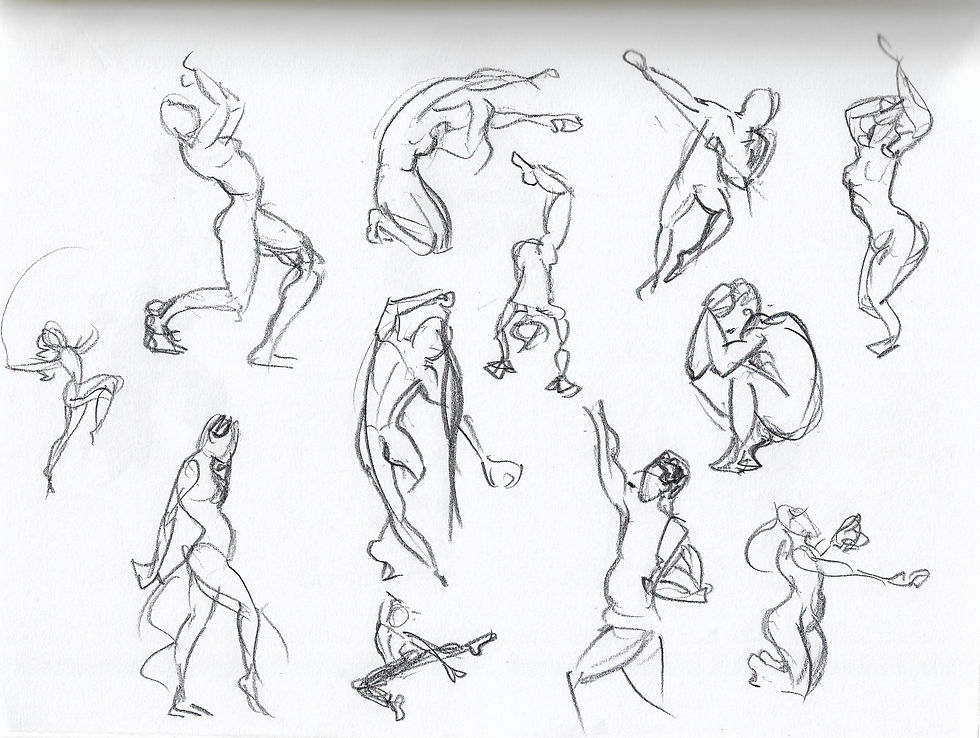
+ Gestural: Gestural drawings are fundamental in drawing the human figure and deriving expression from a figure. I did 2 kinds of gestural drawings, tiny gestural drawing and just normal sized. When you draw small - much like speed painting - you are forced to pick out the most important parts of the body to convey what the body looks like.

+ Muscle group studying & tracings: These are very important and beneficial, I should have done much much much more. I only managed to do a back tracing and some studies and tracings of the anatomy of buttocks. Drawing in muscle groups greatly assists you in learning the names of the muscle, identifying where the fat goes, and learning what bones affect the surface anatomy of that particular part of the body.

4. Final Painting: I allocated a longer period of time to do the final painting and took care in trying to find a really good reference of a body builder. Below are the steps I took in my final painting.
Find the line of action or the "force" of the pose
Draw the simplified anatomical structures over the top
Paint a rough silhouette over the top in a mid-tone colour
Paint in the background or a simple gradient background
Roughly paint the highlights and the shadows and block out the details and lighter shadows
Paint iteration by iteration as to keep the detail consistent over the whole painting and keep going til satisfied and can locate and recognise the muscles of the body without much difficulty.
Edit a filter over the top, this helps bring the painting together. I use the camera raw filter and you can edit everything in one go.
Research, Resources and Annotations
Belovodchenko, A. (2019). belovodchenko's DeviantArt gallery. Retrieved from https://www.deviantart.com/belovodchenko/gallery/
This was a fantastic gallery of photography with great variety in female models - athletic, skinny, muscly, chubby - and fantastic dramatic lighting. Although there is a fair bit of erotic photography in the gallery, the amount of amazing references are worth the occasional "I didn't want to see that" moment. There is also a huge variety in poses, from classic poses to crazy yoga poses that I didn't even know were possible.
Foster, V. (2010). Anatomy and Figure Drawing Handbook. London: A & C Black Publishers.
Although I didn't read through the full length of this little handbook, it was fantastic for referencing what and where bones, muscles and such were. The anatomy charts were very handy as a handbook should be. It also included some information to how we approach life drawing usually in 2 ways: geometric and rhythmic.
Hogarth, B. (2012). Dynamic Anatomy. Dover Publications. and Hogarth, B., & Holden, D. (1989). Dynamic figure drawing. New York: Watson-Guptill.
These were my main resources when beginning studying anatomy. They covered just about everything and provided great tips. There were some moments reading that I didn't understand some of the language but other than that they are very very helpful. One of my favourite tips was that arms consistently have an upward curving rhythm no matter what angle they are placed at, and another was the simplification of the body into various shapes and forms.
HumanAnatomy4Artist. (2019). HumanAnatomy4Artist's DeviantArt Gallery. Retrieved from https://www.deviantart.com/humananatomy4artist/gallery/?catpath=/
This was an extremely helpful resource, although I didn't use it as much as I would have liked to. There is a huge variety in models, in regards to shape, gender and even age (some old men and women). Moreover for almost each pose that one model did there were at least 2 extra shots of the same pose but from different angles around the model. This was especially helpful in understanding the body and muscles with a more 3 dimensional perspective. The lighting in all these photos is very clean and industrial, forcing your eye to work harder in finding the subtle shadows to find muscles (this is good training for yourself).
Mattesi, M. (2013). Force: Dynamic Life Drawing for Animators. Burlington, MA: Focal Press.
A fundamental book in learning life drawing and and anatomy especially as an animator. I really would like to read this again and buy my own copy as it is written very well and straight forward making things really easy to understand. The quality of the drawings are also fantastic and easy to follow, moreover there were some great exercises and tips provided by the book which significantly assisted me in my understanding of how to draw the body. One such exercise was to draw tiny, this way it forces you to choose the best shapes and forms of the body to draw and get the pose across.
Practice Tools for Artists - Line of Action. (2019). Retrieved from https://line-of-action.com/practice-tools/figure-drawing#
I used 3 main pose generators and one of them was this one. It is as simply as it sounds, a pose generator. It carries a huge number of reference photos that people have uploaded and you are challenged to draw whatever pose comes up on the screen with a time limit you select prior to starting. I really like using pose generators as you don't necessarily pick the exact pose and you are forced to draw poses that put you out of your comfort zone.
Proko. (2019). Anatomy of the Human Body for Artists | Proko [Video]. Retrieved from https://www.youtube.com/watch?v=pDgyQjNFVQk&list=PLtG4P3lq8RHFBeVaruf2JjyQmZJH4__Zv
Proko is probably one of my favourite channels on Youtube that provides lessons on anatomy for artists. Hosted by Stanislav Prokopenko, the series linked above is an ongoing playlist of lessons that go through each muscle group, joint and bone and how to draw it. Stan also give you homework to which you can get critic if you join the Facebook group. Although I still have not gotten up to date with the most recent videos, what I have watched so far has been incredibly helpful, it also has been helpful in directing me to other resources.
Quickposes: pose library for figure & gesture drawing practice. (2019). Retrieved from https://www.quickposes.com
Quickposes has been my most frequently used and favourite pose generator that I have used for years, but I've used it so much to the point where I've already drawn two thirds of the pose stock there. Quickposes is always handy for practice. I also used some of the stock I found on it for some of the longer studies I drew digitally.
Ranum, M. (2019). mjranum-stock's DeviantArt gallery. Retrieved from https://www.deviantart.com/mjranum-stock/gallery/
This gallery is filled with a huge number of really creative pose references. It includes both costumed and nude references. There is even a sub-folder for classical nude poses. The quality of the photos are fantastic. I wish I had used this resource more, but will definitely be coming back to it to use it.
Simblet, S., & Davis, J. (2001). Anatomy for the artist. London: Dorling Kindersley.
A very well put together book that covers everything. I read this one a bit later in the project as I could not find it earlier in the library but really wished I had more time to read it for this project (It's on my Christmas wish list). The book is full of great explanation, fabulous anatomical drawings and parchment paper tracing overlays. I highly recommend this book when learning to draw anatomy.
TheMaleNudeStock. (2019). Action Poses by TheMaleNudeStock. Retrieved from https://www.deviantart.com/themalenudestock/gallery/34747005/Action-Poses
As can be gathered from the title, 100% of the pose stock in this gallery is male. There is a fantastic variety in poses, though the resolution of the photos is sometimes a bit low and the lighting can sometimes be a bit dark. There was a few poses that I really wanted to draw from this gallery but only got around to one of them.
Ward, C. (2015). Human Anatomy for Animators - the Skeleton and Muscles. Retrieved from https://www.animationsalvation.com/anatomy-for-animators-01-the-human-skeleton-and-muscles/
This was the first resource that I looked at when starting my anatomy research and search for stock galleries. It's a great introduction to anatomy for animators and provides great direction for what you should study and a great overview of the functions of and types of muscles and tendons. It even provides a video of anatomy in animation with a clips from the game Watch-dogs.
Appraisal
My goals of focusing on anatomy have been well met this trimester. I feel like I have made a mammoth improvement in my knowledge and I am very keen to utilise it and keep working on it. At first I thought I hadn't made much progress but when I flipped through some of my life drawing pieces from 2017 I felt really good about the improvement I made. Moreover I feel like I have overcome my slight fear over painting and drawing digitally as I have always been a stickler for traditional methods, printing, painting and so on. Now I am much more comfortable and more open to the digital method.
I definitely could have done a lot more drawing but I was so caught up in all the reading and now realise that I should have scoped it down to an extent as there is so much to learn in anatomy and even having a general skim over everything is a huge task. In future I am hoping to continuously study anatomy and use it to my advantage in character animation, character design, modelling, sculpting and more.
Cheers,
Grassland
Body of Work
Here is all of the work that i could gather from this project




Comments