


The Drunken Dragon: Project Breakdown
- Savannah Edwards

- Nov 11, 2018
- 7 min read
Updated: Dec 9, 2018

Brought to you by '404 Team Not Found' the Drunken Dragon Aftermath project is an environment of the aftermath of a fantasy tavern fight. A party of infamous adventurers stay in this tavern only to end up fighting their way out, leaving a scattering of their belongings and a trail of destruction inside. The fight begins with a card game, the rogue of the party is caught slipping a card into her sleeve. The table is flipped, cards go everywhere, the rest of the party stands up, the kenku's hood slips and reveals her face. It is realised that this band of adventurers are wanted for crimes against the crown.
You awaken from a long rest and make your way down stairs to bear witness to the carnage of the previous night’s exploits....
Workflow Breakdown
We worked in various stages to complete the project:

1. Brainstorm & Research: As soon as we had been given the project out team sat together to figure out what kind of environment we had wanted to make. Initially we had thought of a horror scene with a derailed train or something of the like, talked about portals and so on. Suddenly I thought of a tavern fight and we excitedly spun off that, listing assets we would potentially need and possible stories that we could convey.

2. Planning & Paperwork: Following from our brief brainstorm, we got stuck into creating the Project Plan and Art Bible. I set up an asset list as well as starting a Gantt chart which Alana had helped fill out as I wasn't too fantastic at the chart for last trimester. We assigned everyone their assets, splitting them just about evenly. Everyone also collected inspiration, references, made mood boards, wrote the story and did sketches. I made a few sketches for some liquor bottles and characters.

3. Greybox & Blockout: The greybox stage was rather important to us for getting the layout right . There were play-tests conducted for this to get some well needed feedback. The issue with this stage was the fact that a lot of our placeholders for the mess and broken objects didn't really convey what was needed to be conveyed as they were just little grey boxes seemingly randomly placed around...
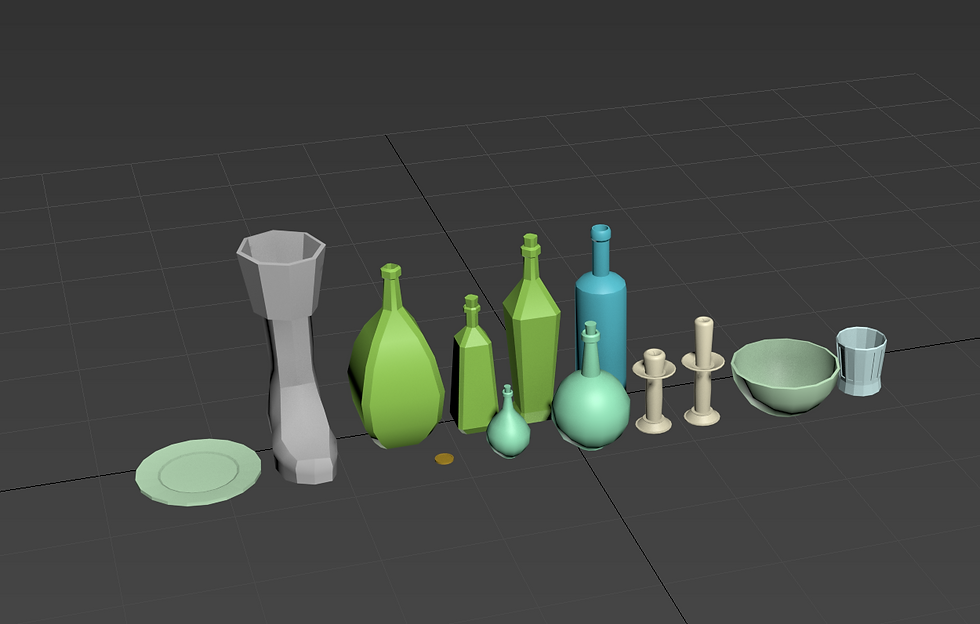
4. Proxy Blockout: A more refined version of the greybox - which included more refined placeholder assets - was created for another round of play-tests and to assure our team that the layout and assets were right in telling the story. We were happy with how this stage turned out as got a lot of positive feedback. I made a lot of smaller assets which took up most of the mess.

5. Finishing the assets, unwrapping & Texturing: Here we went ahead and further developed our proxies for the final. This stage consisted of chamfering edges, unwrapping our assets and then texturing them in either Substance Painter or Quixel Suite. I had a few technical difficulties with Substance on my laptop, though I pulled through and ended up using one of my team mates computers and textured a number of assets.

6. Final: The previous stage and this final stage were done simultaneously where we would swap out the proxy assets for the finals. Most of the time in this final stage was doing this and making sure the chaos was making sense, as well as adding last minute details and decals (wanted posters and the menu art). There was a fair bit of time spent on lighting too.
Research & Resources & Annotations
Most research conducted was looking at tutorials and finding inspiration and references for particular assets and how to use programs like Substance Painter - I learned most of what I know about Substance by asking a team mate for help though. A lot of the resources I used helped me make sense of the workflow we should follow as well as getting my brain jogging to think of new ideas and so forth.
McGuire, H. (2018). Unreal Engine 4 C++ Tutorial: Pick Up, Rotate, and Throw Object Like Gone Home [Video]. Retrieved from https://www.youtube.com/watch?v=sXNDeImnipU : Though I never really got to input this into the final project, it certainly gave me a good spoonful of information about how Unreal's visual scripting/blueprints worked and what it could do. I am keen to give it another try over the holidays or whenever in my own time as though it was frustrating I found it rather interesting.
New Frame Plus. (2018). Learn More About Game Animation - New Frame Plus [Video]. Retrieved from https://www.youtube.com/watch?v=xMYsmq73-vI : This was a great gateway into helping find other animators and resources that are awesome inspirations and resources for me to refer to in future and throughout this project. It was a very helpful video that got me more interested in delving more into the animation community.
Schatz, E. (2017). Defining Environment Language for Video Games. Retrieved from https://80.lv/articles/defining-environment-language-for-video-games/ : I found this article to be rather helpful in understanding the workflow that goes into making environments and level design. I found it really really helpful and comprehensive and rather interesting seeing how players can often interpret things in a game and so on.
Simpson, T. (2018). 8 Tips For Artists Struggling With Motivation. Retrieved from https://www.polygon-academy.com/tips-for-artists-struggling-with-motivation/ : An article I found to be a needed reminder for my general habits. It's actually an article I have been forwarding on to a lot of my friends struggling with getting their work done and such. It's been rather helpful to me.
Sound Attenuation. (2018). Retrieved from https://docs.unrealengine.com/en-US/Engine/Audio/DistanceModelAttenuation : Despite not getting sound into the final project this was a really helpful article when I was trying to get it in. It provides examples of how different sound effects look on a graph as well as concisely explaining various definitions when it came to audio in games.
Symeou, D. (2017). Unreal Engine 4 - Adding sound and music [Video]. Retrieved from https://www.youtube.com/watch?v=XTwIhQHsCB4 : A straightforward video that assists in adding basic sound and music to the scene. I had initially found it helpful for basic sound additions but realised the products of the video did not exactly suit the needs of the project.
Bethesda Softworks. (2013). The Elder Scrolls V. Skyrim. Rockville, MD : The taverns, inns and pubs in Skyrim provided awesome and great inspiration for our project. When we brought it up in our brainstorming session I actually went back home and played it a bit to have a look at Whiterun's Bannered Mare tavern to get some ideas about layout and potential assets.
WorldofLevelDesign. (2016). UE4: How to Create Your First Decal Material Tutorial [Video]. Retrieved from https://www.youtube.com/watch?v=2lYeGVQqcr8 : This was an easy and concise tutorial for making decals in Unreal . I was initially going to make decals but didn't end up being able to get to and so I forwarded this on to a team member (Alana) to make decals.
Post-Mortem: A Reflection On Stuff That Went Down.
We cool (Positive): One of my favourite things about this project was our team dynamic. For almost every aspect of the project, each of us had some kind of input. We all asked each other for advice and help and I think it was just so awesome. Sure there were issues or complications with software or tasks though the way we all handled all of these issues was really great. We improvised, adapted and overcame , all the while still staying friendly and chill with each other.
Where's your work? (Negative/Positive): There were issues with getting work from an inactive team member which was rather frustrating as we had assigned them some rather important assets that were key in conveying the story. We tried to gently pressure them to produce something that we could put in the scene but didn't yield much. Though the positive thing that came out of this was that when push came to shove the rest of the team distributed the left over assets and tasks needed to be done and got what needed to be done, done. Moreover there were no hard feelings or a lot of tension between us all, I'm glad that we were all cool headed and just got on with the project and stayed friendly with each other even in times of frustration. I think the way we overcame the situation was really great and didn't hurt us in the work load area as we all shared the load.
Give us a hand? (Positive): I admit I'm was really not great in using Unreal Engine during the project and I still am not great, though this was not much of a problem as we all helped each other out. When one of us was struggling with something each team member would share their expertise and give whoever needed it a hand. It was really reassuring having people who were more knowledgeable in the team to ask quick questions and to solve problems with. I think this was a result of us all staying really cool and open with each other, of course it really helped that we were already friends before this project, but I think all our attitudes were real awesome.
I'll pick up where you left off (Positive) : Probably another one of my favourite things about this project was the fact that when someone couldn't do something or finish an asset someone else would quickly jump in and pick up the work from where it left off. This happened a number of times throughout the project where people were away from computers or there were technical errors and tasks couldn't be carried out. For example for one of the last minute assets - the doors upstairs - I made a very primitive version that wasn't quite finished and was unable to complete it due to external reasons and Alana picked up from where I left off and created an awesome asset for us to use. Another example is when some people are focusing on creating larger, more intricate assets or busy with arranging the scene some of us would take responsibility for the texturing of their assets so there was no wasted time. We could really rely on each other to get things done and I think a lot of this was credit to our love and excitement for the project as well as our attitudes.
Appraisal
I believe we followed through on our original idea rather successfully, I think we were all very pleased with how the whole project turned out. I think what was really great was that we all settled on the one idea rather quickly and got to work on producing ideas and so on. Nothing much had changed from our initial idea other than having a huge portal with tentacles which I think was a great addition to showcase the talents in our team. To be very honest I don't really know what to say other than I'm awesomely pleased with what was produced. It's really fantastic to see the fruits of our labour. We of course are still going back to make small tweaks and fixes to further improve the project. Overall I think it turned out how we envisioned it to be, I'm grateful to have had such an awesome team to work with.
Cheers,
Grassland


Comments