


Pondering on: Copyright, Clear as Mud.
- Savannah Edwards

- Aug 16, 2018
- 5 min read
Updated: Aug 17, 2018

Ownership of the expression of an idea. Not the idea.
Copyright is a hot, messy and complicated topic, tangling creators, companies and the law in its never ending knots. Copyright boiled down, is ownership of an original kind of any tangible expression of an idea. Its function, to protect that ownership. Simple at first, but the equation becomes rather confusing when you throw in fair use, fair dealing, public domain, and people who haven't done enough research trying to sue someone for "stealing" their idea. As an emerging creative professional, I've come to realise that it's rather important for me to be aware of and understand the parameters of ownership people have over their own creations. In a nutshell, I'll be exploring the ins and outs of Copyright in Australia and the United States, as these will be the markets I will more than likely be entering.

In Australia, "Copyright protection is free and applies automatically when material is created" (Australian Copyright Council [ACC] , p1, 2017). The system "...does not protect ideas, information, styles, ... techniques... names, titles..., slogans" or people and their images (ACC, p1-3, 2017). It does protect: textual material, computer programs, compilations, artistic works, dramatic works, musical works, cinematograph films, sound recordings, broadcasts and published editions; as long as they are original works (ACC, p2 2017). This protection does not last forever , at a certain point in time it must pass on to the public domain (with Disney's constant lobbying for extensions for rights to good old Mickey Mouse in the U.S. as an exception. [Crockett, 2016]). Initially only lasting 50 years after the death of the creator up to 2005, this time period was extended to 70 years post death for Australian creators under the Free Trade Agreement with the U.S (ACC, p6, 2017) .
Hold on a second what's Public Domain? I'm sure you've figured that out, but just to make it clear. As Stephen Brooks, from RubberOnion puts it, quite simply, "Public domain is public property and Copyright is private property" (2015). When work is passed onto the public domain, an individual no longer own it, making it free to use and distribute as the public wishes to. So, my work isn't mine forever? Copyright is posed by the government as an incentive for creators to come up with original and new works, it's a system that acknowledges that it is hard to make money off original content (especially for emerging artists) by protecting that content. To creators, having their work pass onto public domain seems somewhat daunting (despite the fact that they'll be long gone before then). Little do many creators realise, is that "...a robust public domain is essential to the progression of creative public expression." (Brooks, 2015).
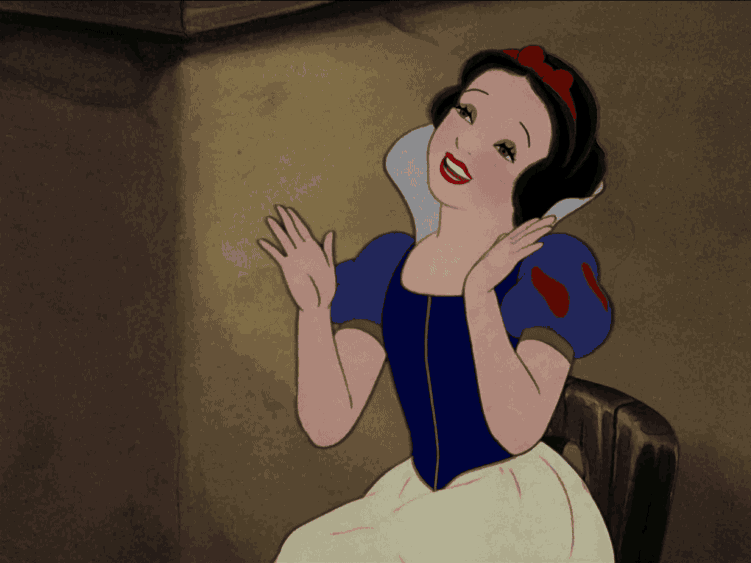
How so? Well take a look at Disney for an example. This powerhouse of the animation and entertainment industry has been building its success off the backs of fairy tales and legends that have long been in the public domain. Some of these include: Brothers Grimm's Snow White, Hans Christian Anderson's Little Mermaid and Ice Queen (Khanna, 2014). These stories can still be retold and expressed in different ways as the stories remain in public domain, as long as they do not mimic Disney's expressions of these stories remain under copyright. Albeit the fact that these films are based off previous works, Disney should not be put to a discredit as Disney still needed to write scripts, design characters, worlds and so on. Take a look at this list from Forbes showing some of Disney's most successful movies based on public domain works.
With Disney in mind we can understand better that all new things that we do is based on something before it.
However when something is obviously based upon something else, and that something else's copyright hasn't expired yet - unless permission has been granted or the rights have been purchases - this is known as copyright infringement. There are times, though, when certain criteria are met that infringement can be eligible for exemption. The criteria that need to be met are specific and narrow, the Australian Copyright Council states that "... there is no general exception for using copyright material simply because you think it is fair or because you are not making a profit. The Copyright Act allows you to use copyright material without permission if your use is a "fair dealing"..." (p2, 2017). These fair dealings are comprised of: research or study; criticism or review; parody or satire; reporting news; giving persons with disability access to material; or professional advice from legal representatives such as a lawyer, patent attorney or trade marks attorney (ACC, p2, 2017).
Often confused with fair dealing in Australia, is "fair use", an exception in the United States. "Unlike U.S. copyright law, Australian law does not have a general "fair use" defence." (ACC, p1, 2017), though it has been inquired and recommended that "fair use be introduced by the Attorney-General and Australian Law Reform Commission (ALRC) . "Fair use" is an appropriate defence in U.S. court but more than often hard to prove as the definition of "fair" is unclear and really dependant on the judge.
Like the current Australian exceptions, in order to rely on the US exception, the use must also be fair and what is “fair” is not specifically defined.
- Australian Copyright Council, p4, 2014
The factors that go into the consideration of whether an un-permitted use of copyright material is "fair use" (in the U.S.) consist of:
Purpose and nature of the use (is it being used commercially? non-profit educational purpose?)
Nature of the copyright work itself
The amount and substantiality of the portion used in relation to the copyright work; and
the effect the un-permitted use may have on the market in which the original work is competing in.
(ACC, p4, 2014)
In an inquiry from the ACC, the ALCR suggested the following factors also should go into consideration:
Whether or not it's non consumptive use
private and domestic use
transformative use (as well as quotation and educational use)
and use for public administration
(ACC, p7, 2014)
An interesting case of copyright infringement I find myself and other fellow artists to be breaching often is that of Fan Art, Fan fiction Cosplay. Drawing and dressing up as your favourite characters is a copyright violation. Do not fret though, as copyright holders of your favourite characters are often not threatened by your loving copyright violations. Rather they are quite excited about it. However, if your fan art were to hit the market (ie: selling prints, t-shirts and such of characters or logos that are not your own), you would be in a bit of a pinch - unless you have been licensed or given the permission to do so (Rose, 2016).
Personally, I wont be stopping drawing my favourite characters any time soon, nor will I remember every point I researched here. Though I do now understand the tangled mess that we call copyright, I do hope I brushed out a few knots for you and that you will go further into exploring what copyright is and how it affects you.
Cheers,
Grassland.
16/08/2018
Bibliography
References:
Australian Copyright Council (2014). Fair use & the ALRC Inquiry. Strawberry Hills, NSW, pp.1-9.
Australian Copyright Council (2017). An Introduction to Copyright in Australia. Strawberry Hills, NSW, pp.1-10.
Australian Copyright Council (2017). Fair Dealing: What Can I Use Without Permission?. Strawberry Hills, NSW, pp.1-6.
Bailey, J. (2015). Copyright Myths - Plagiarism Today. Retrieved from https://www.plagiarismtoday.com/stopping-internet-plagiarism/your-copyrights-online/3-copyright-myths/
Brooks, S., & Yulfo, R. (2018). Copyright and What Animators Need to Know About It. [Podcast]. Retrieved from https://rubberonion.com/copyright-and-what-animators-need-to-know-about-it-parody-fair-use-fan-art/
Crockett, Z. (2016). How Mickey Mouse Evades the Public Domain. Retrieved from https://priceonomics.com/how-mickey-mouse-evades-the-public-domain/
Kenyon, A. (2007). TV Futures: Digital Television Policy in Australia. Carlton, Vic.: Melbourne University Press, pp.166-170.
Khanna, D. (2014). 50 Disney Movies Based On The Public Domain. Forbes.com. Retrieved from https://www.forbes.com/sites/derekkhanna/2014/02/03/50-disney-movies-based-on-the-public-domain/#57d671c0329c
Rose, M. (2016). Cosplay Goes to the Supreme Court - Public Knowledge. Retrieved from https://www.publicknowledge.org/news-blog/blogs/cosplay-goes-to-the-supreme-court
Images & GIFs:
PanMacillan (2017). Alice In Wonderland Header [Image] Retrieved from https://panmacmillan.azureedge.net/pml/panmacmillancorporatesite/media/blogs/tws/august%202017/alice-in-wonderland-knowledge-quiz-header.png?ext=.png
Giphy (undt.). Steamboat Willie Mickey Mouse [GIF] Retrieved from https://giphy.com/gifs/disney-bw-mickey-mouse-r1jbtDXIAjq92
Giphy (undt.). Snow White Clapping [GIF] Retrieved from https://media.giphy.com/media/LfwMyRpf9X6q4/giphy.gif


Comments